The connection was lost. Trying to connect again.

Post by Kris

Earlier in the thread

Martin Seeger @masek@infosec.exchange

Die Frage ist auch "Sicher für wen?"

tagesschau.de/inland/gesellsch

Die SUVs sollte man Sankt-Florians-Kutschen nennen, da sie halt andere Menschen umbringen statt der Insassen.

Die "Sicherheit" der SUVs ist vermutlich sogar Netto-Negativ. Gibt es dazu Untersuchungen?

#verkehr

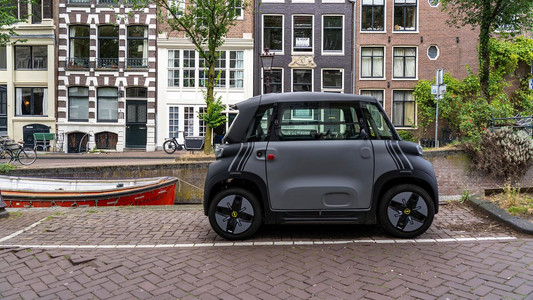
tagesschau.de Microcars boomen - aber wie sicher sind sie? Sie sehen aus wie Kleinwagen, sind aber keine: Microcars sind maximal 45 km/h schnell und dürfen in Deutschland schon ab 15 Jahren gefahren werden. Wie sicher sind die beliebten Mini-Autos? Von Hermann Scholz.

· Public

Kris @isotopp@infosec.exchange

@masek

Meta-Analyse injuryprevention.bmj.com/conte

Questions In the case of a road traffic crash, do sports utility vehicles (SUVs) and light truck vehicles (LTVs) cause more severe injuries to pedestrians and cyclists than passenger cars? Does any effect differ between adults and children?

Design Systematic review and meta-analysis.

Data sources MEDLINE, TRID and Global Index Medicus were searched up to September 2024, with no restrictions by setting or language.

Inclusion criteria Eligible studies had to compare injury severity between pedestrians and/or cyclists hit by an SUV or LTV versus a passenger car. Only sources using real-world crash data were included.

Main outcome measure Injury severity, defined either as ‘fatal versus non-fatal injury’ or as ‘killed or seriously injured (KSI) versus slight injury’.

Results 24 studies were included in the meta-analysis. The results were similar between pedestrians and cyclists. When combining pedestrians and cyclists, the pooled odds of KSI versus slight injury if hit by an SUV/LTV versus a passenger car were higher among adults/all-age samples by 1.24 (95% CI 1.15, 1.34) and higher among children by 1.28 (95% CI 1.19, 1.37). The odds of fatal versus non-fatal injury if hit by an SUV/LTV versus a passenger car increased among adults/all-age samples by 1.44 (95% CI 1.33, 1.56) and among children by 1.82 (95% CI 1.57, 2.11; p=0.006 for heterogeneity by age).

Conclusion In the case of a crash, SUVs and LTVs cause more severe injuries to pedestrians and cyclists than passenger cars. This effect is larger for fatalities than for KSIs, and the fatality effect is particularly large for children.

Injury Prevention Do sports utility vehicles (SUVs) and light truck vehicles (LTVs) cause more severe injuries to pedestrians and cyclists than passenger cars in the case of a crash? A systematic review and meta-analys Questions In the case of a road traffic crash, do sports utility vehicles (SUVs) and light truck vehicles (LTVs) cause more severe injuries to pedestrians and cyclists than passenger cars? Does any effect differ between adults and children? Design Systematic review and meta-analysis. Data sources MEDLINE, TRID and Global Index Medicus were searched up to September 2024, with no restrictions by set

· Public · edited

Replies

Kris @isotopp@infosec.exchange

@masek

iihs.org/research-areas/pedest

Pedestrians and Cyclists

Die Studie ist eigentlich als Pro-Helmet-Law Studie konzipiert.

Was hilft:

Geschwindigkeiten reduzieren (Effekt: Energiereduktion im Aufprall, Quadratisch)

A recent IIHS study using U.S. pedestrian crashes found the average risk of serious injury or worse to a pedestrian increased from 18% at an impact speed of 20 mph to 32% at 25 mph, 67% at 35 mph, 90% at 45 mph, and 97% at 55 mph

Separation:

One key strategy for protecting pedestrians and bicyclists is to separate them from motor vehicles — for example, with sidewalks or bike lanes

A 2023 study in the U.S. found separated bike lanes are more safety-effective than traditional painted bike lanes

Separation in Intersections:

Pedestrians and bicyclists can be separated from traffic as they cross the street by overpasses, underpasses, and median islands in busy two-way streets

Und Vehicle Design:

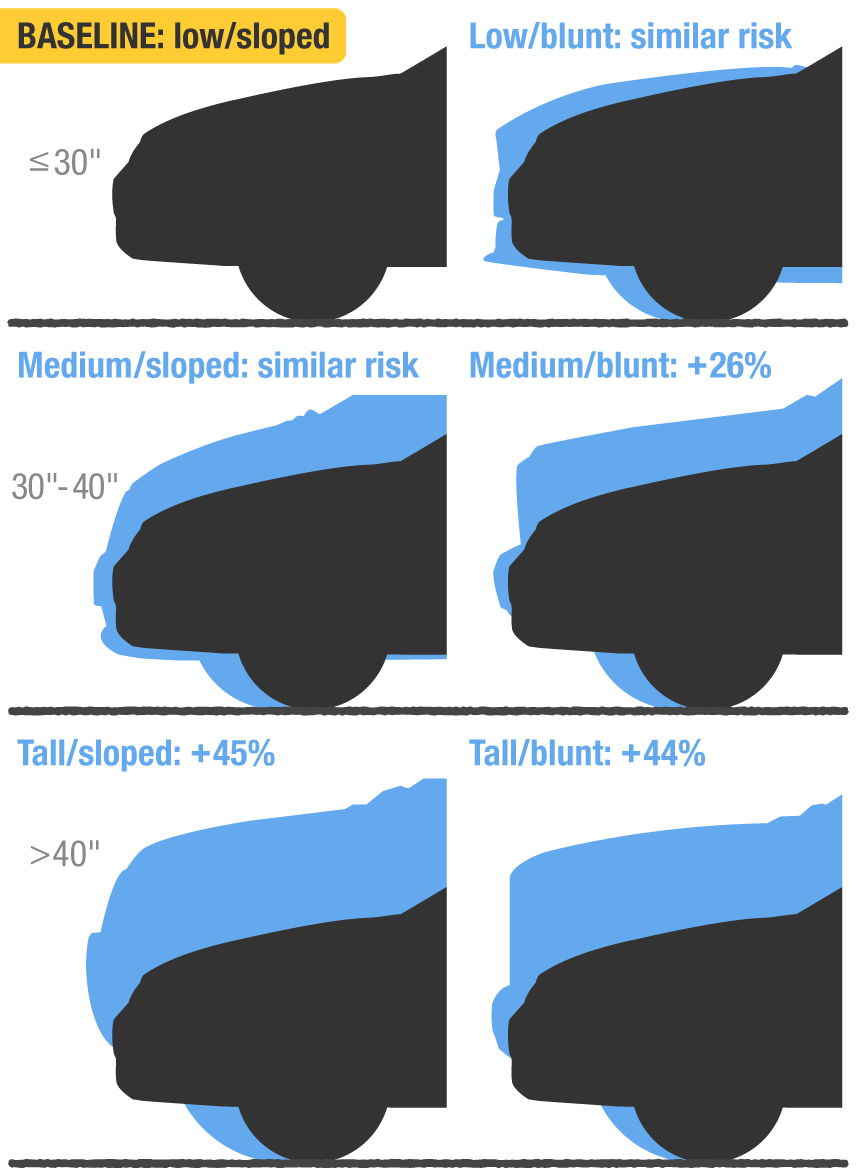
Pedestrians and bicyclists are more likely to die or be seriously injured when struck by SUVs or pickups than when struck by cars

Außerdem schlechte Sicht:

A 2022 IIHS study found that SUVs, pickups and vans are more likely to strike pedestrians when making turns than cars, relative to when they are traveling straight at intersections (Hu & Cicchino, 2022). This finding suggests that visibility while turning may be an issue for these bigger vehicles.

Das ist das typische "Lastwagen mangelt Radler beim Abbiegen über", aber mit SUV und Amateurfahrer.

· Public · edited

Kris @isotopp@infosec.exchange

@masek

SUV verursachten schwerere Verletzungen, insbesondere Kopfverletzungen. Verletzungen durch den Aufprall auf den Boden waren mehr als doppelt so häufig wie bei Kollisionen mit Pkw. Die höhere Fahrzeugfront begünstigte das Umstoßen und Überrollen von Radfahrern.

pubmed.ncbi.nlm.nih.gov/373583

Results: Bicyclist injuries from crashes with SUVs were more severe than those from crashes with cars, particularly with respect to head injuries. The greater injury severity associated with SUVs was related to these vehicles' tendency to produce injuries from ground contact or from vehicle components near the ground. In contrast, cars were much less likely to produce ground injuries and instead tended to distribute less severe injuries across multiple vehicle components.

Conclusions: The pattern of results suggest that the size and shape of SUV front ends are responsible for the differences in bicyclist injury outcomes. In particular, we found that SUV crashes inflicted more severe head injuries compared with car crashes and that SUVs were disproportionately likely to throw bicyclists to the ground and run them over.

PubMed Bicyclist crashes with cars and SUVs: Injury severity and risk factors - PubMed The pattern of results suggest that the size and shape of SUV front ends are responsible for the differences in bicyclist injury outcomes. In particular, we found that SUV crashes inflicted more severe head injuries compared with car crashes and that SUVs were disproportionately likely to throw bicy …

· Public

Kris @isotopp@infosec.exchange

@masek pubmed.ncbi.nlm.nih.gov/401006

Crash incompatibility between cars, SUVs, and pickups in 2017-2022

Das zentrale Ergebnis ist, dass zusätzliches Gewicht bei bereits schweren Fahrzeugen nur noch einen geringen Sicherheitsgewinn für die eigenen Insassen bietet, gleichzeitig aber das Risiko für Insassen des Unfallgegners deutlich erhöht.

Besonders schwere SUV über rund 2.268 kg waren im neueren Untersuchungszeitraum mit einer 1,2-fachen Todesrate beim Fahrer des kollidierenden Pkw gegenüber Pkw-Pkw-Kollisionen verbunden.

PubMed Crash incompatibility between cars, SUVs, and pickups in 2017-2022 - PubMed Crash incompatibility in the fleet has continued to improve in recent years, particularly among the heaviest pickups and SUVs. Although curb weight remains an important factor in driver protection, our data suggest that the benefit plateaus at 4,000 lb, with minimal incremental gains above this poin …

· Public · edited

Kris @isotopp@infosec.exchange

@masek

10-Minuten-Takt:

link.springer.com/article/10.1

In a survey (Van Oort 2014), we concluded that passengers tend to arrive at random if headways are 10 min or less. This conclusion supports earlier findings of O’Flaherty and Mangan (1970) and Seddon and Day (1974) who stated that passengers arrive at random if scheduled headways are shorter than 10–12 min.

journals.sagepub.com/doi/10.31

An 11-min vehicle headway was identified to mark the transition from practically random to less random passenger arrivals, and all transit users can be regarded as coordinated arrivals after 38-min bus headway

und viele andere mehr.

Content cover image SpringerLink Incorporating enhanced service reliability of public transport in cost-benefit analyses - Public Transport In this paper, we demonstrate how to calculate the passenger impacts of service unreliability. We show that passengers are affected by longer waiting times and the distribution of travel times. We present a framework to calculate these effects and to express them in monetary values. In the Netherlands and many other countries, service reliability is not explicitly incorporated in cost benefit anal

· Public

Kris @isotopp@infosec.exchange

@masek Dazu gibt es wortwörtlich Dutzende von Veröffentlichungen.

Generell gilt, daß Transportaufgaben im Straßenverkehr primär berührungslos zu lösen sind, um Unfälle zu vermeiden.

Ist eine Berührung von Verkehrsteilnehmern oder Straßenumfeld nicht zu vermeiden, ist der Unfallausgang um so besser, je geringer die involvierten Energien sind.

Die sind aber E = 1/2 v^2 * M. Dabei ist v die Relativgeschwindigkeit bei Berührung und M die Summe der involvierten Massen.

Daher ist es quadratisch wichtig, Geschwindigkeiten zu verringern und linear wichtig, Massen zu verringern.

Das ist die Physik, die alle Verkehrssicherheit steuert. Alle Maßnahmen lassen sich im Lichte dieser Gleichung sehr simpel evaluieren:

  • Trennung von nicht-motorisierten Verkehrsteilnehmern, Trennung von Fahrbahnen
  • Verlangsamung des motorisieren Verkehrs durch Gestaltung der Fahrbahn (Verengung; Fahrbahnschwellen; scharfe rechtwinklige Kurven, die beim Abbiegen (und Kreuzen von nicht motorisiertem Verkehr) einen Stop oder eine starke Verlangsamung erzwingen; Kreisel (siehe Kurven zuvor)
  • Reduktion von Massen durch Förderung leichterer Fahrzeuge wie Fahrräder, Lastenräder, L-Klasse Fahrzeugen und Gewichtsbeschränkung für M-Klasse Fahrzeuge auf 2t oder weniger incl. Treibstoff oder Batterie, Verbot des Privatbesitzes von Lieferfahrzeugen (auch Camper) – nur gewerblicher Besitz und Miete

Unterstützend ein Ausbau von ÖPNV und Verdichtung des Taktes auf 15 Minuten oder weniger; Untersuchungen zeigen, daß Fahrgäste bei einem Takt von 10 Minuten nicht einmal mehr auf den Fahrplan schauen, sondern sich einfach auf gut Glück aufstellen.

Dazu dann noch ein Rückbau des Straßennetzes; das ist auch finanziell geboten; Deutschland ist derzeit ca. 100% Overcommitted, was den Unterhalt des Straßennetzes angeht. Das Straßennetz muß also in etwa halbiert werden, um finanziell unterhaltbar zu sein.

· Public · edited